Journal · · 5 min read · Updated
The case for a native App Store screenshot tool
App Store screenshots are the highest-leverage assets in the indie marketing stack and most indie developers, including past versions of me, treat them as the worst chore of every release. Mockly is the studio's argument that the workflow should be a native Mac app, not a YAML-driven CI script.
App Store screenshots are the most underrated assets in the indie iOS marketing stack. They are the first thing a prospective user sees in a search result. They convert better than any description, any keyword, any rating. And most indie developers, in my own anecdotal sampling, treat them as the worst chore of every release.
I treated them that way for five years. Mockly is the studio’s argument that there is a better way, and the rest of this post is what I learned shipping it.
What is the fastlane status quo for App Store screenshots?
The dominant solution for screenshot generation in the iOS indie world is fastlane snapshot — a Ruby tool that drives the iOS simulator, takes screenshots in every required device size, and writes them to disk. Combined with fastlane frameit (which adds device frames) and fastlane deliver (which uploads to App Store Connect), it constitutes a complete pipeline.
I am not going to dunk on fastlane. It is genuinely useful, the team behind it has done a public service for indie developers for nearly a decade, and the tool is open source. If you have a deeply customised CI pipeline already and your screenshots fit within the templates fastlane provides, it is a reasonable choice.
What it isn’t, structurally, is comfortable. The workflow is:
- Write Swift UI tests that drive your app to specific screens.
- Maintain a YAML config of devices, locales, and target screens.
- Run a Ruby command-line tool that takes 30-90 minutes for a multi-locale ship.
- Hope that nothing in iOS or Xcode broke the simulator automation since last release.
- Manually swap or recompose any screenshot that needs editorial work — text overlays, multiple devices in one image, before/after pairs.
- Ship.
The friction is everywhere in this list and it compounds. The Swift UI tests rot. The YAML grows. The simulator silently changes its rendering between Xcode versions. The editorial work happens in a separate tool — Pixelmator, Photoshop, or hand-coded SwiftUI — which means the editorial assets and the automated assets diverge over time. By the third release, half the studios I know have given up on the automated path and are screenshotting the simulator by hand.
The native-app argument
The core bet behind Mockly is that most indie screenshot needs are a GUI problem, not an automation problem.
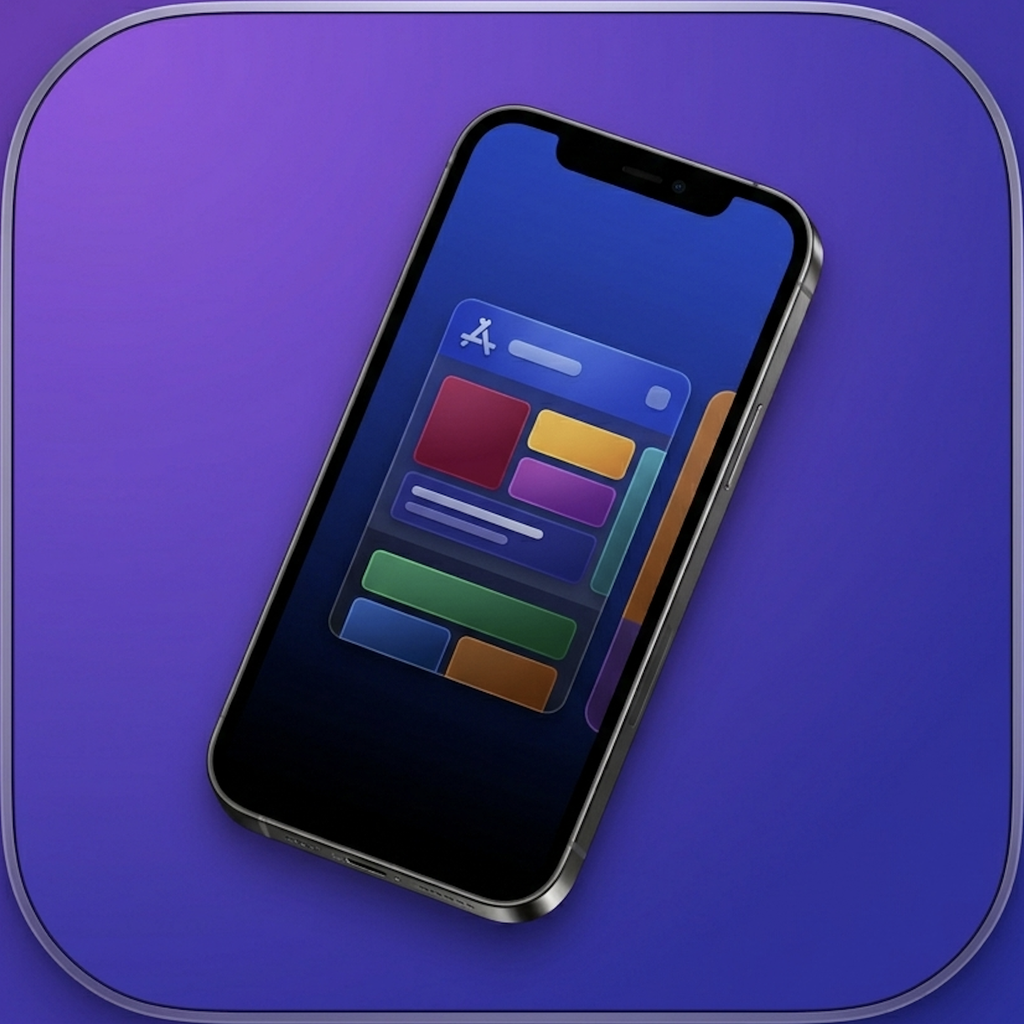
A GUI tool gives you direct manipulation of the asset. You drag the screenshot from the simulator into the app. You pick a device frame from a library. You add text overlay, you compose multi-device layouts, you preview the final result instantly. The locale switcher swaps the underlying screenshot but keeps the layout. The 3D frames are rendered live, not as PNG overlays — meaning a four-degree rotation looks correct, with proper perspective and lighting, in a way a flat composite cannot match.
The output is the same — PNG files at the App Store’s required dimensions — but the workflow is fundamentally different. Each screenshot becomes a small, owned asset that can be edited and re-exported as needed, instead of a regenerated artefact that is slightly different every time the simulator rolls.
For studios that ship a polished, editorially-considered set of screenshots — the ones with multiple devices in one image, with overlay copy, with motion blur on transition shots — this is the workflow that fits.
What Mockly specifically does
The feature set, briefly:
- 3D Metal-rendered device frames. Every iPhone and iPad model from the last six years, rendered at the screenshot composition time. Rotation, perspective, lighting, and reflections are real, not faked.
- Localised composition. A single layout, with text, multiple devices, and overlays, can be exported across 20+ App Store regions in one click. The locale switcher swaps screenshots and translates copy.
- Direct upload to App Store Connect. No fastlane deliver step. The app talks to the ASC API and pushes to the right per-locale slot.
- Templates. A library of professionally-designed templates for common patterns — the four-screenshot hook, the before-and-after, the device-and-watch pairing.
- Editorial workflow. Custom layouts, free positioning, drag-and-drop. The full composition tool that fastlane doesn’t try to be.
It does not, deliberately, replace the automation pipeline. If your studio has a deep CI/CD investment and screenshots that need to regenerate from running tests on every release, fastlane stays in your stack. Mockly is for the editorial moment that lives upstream of the pipeline — the deciding what the screenshot says part — and for the studios for whom that’s the bulk of the work.
Why $12.99 lifetime, with Family Sharing
The pricing decision here is the most aligned with the AppMeta pricing decision from a few weeks back: a one-time purchase, lifetime access, no subscription required.
The specific addition for Mockly is Family Sharing support. A two-developer studio (me and a co-founder, two indie partners, a couple-run studio) can share a single $12.99 license. This was a deliberate choice — the alternative would have been per-seat pricing, which is the right call for SaaS but the wrong call for a tool that small studios use intermittently.
The studio loses some revenue to Family Sharing. The studio gains, I think, the right shape of relationship with the user. A small indie tool should treat its small indie users as a household, not a contract.
What this post does not argue
I’m not arguing every iOS developer should switch to Mockly. The largest, most automated indie pipelines are well-served by fastlane — and many of them have invested years in customisations that would be expensive to abandon.
What I’m arguing is that a meaningful fraction of indie developers — the studios where screenshot work is editorial first and pipelined second — would be better served by a GUI tool than a CI script, and that almost no one builds GUI tools for indie iOS workflows because the audience is “just” tens of thousands of developers globally.
That audience is the audience this studio happens to be in. Mockly is for them. $12.99, lifetime, Family Sharing supported. If it doesn’t fit your workflow, fastlane will still be there next release.
If you’ve ever sworn at a Ruby script in the middle of a Friday ship, this might be the weekend to reconsider what part of the chore is actually necessary.
Questions
Frequently asked
Is there a native Mac alternative to fastlane snapshot?
How much does Mockly cost?
Does Mockly replace fastlane entirely?
How are device frames rendered in Mockly?
Mentioned in this post
Apps in this story

More from the journal