Journal · October 9, 2026 · 8 min read
Designing a puzzle with no words: how Tare teaches its rules, and what accessibility took
Tare has 80 levels and not one word on the playing field: no tutorial screen, no arrows, no “drag here”. The puzzle had to teach itself, and with no text to label, accessibility had to reach the board itself. Here is what the first levels teach and how, then what it took to make the same puzzle work with VoiceOver, high contrast and large type.
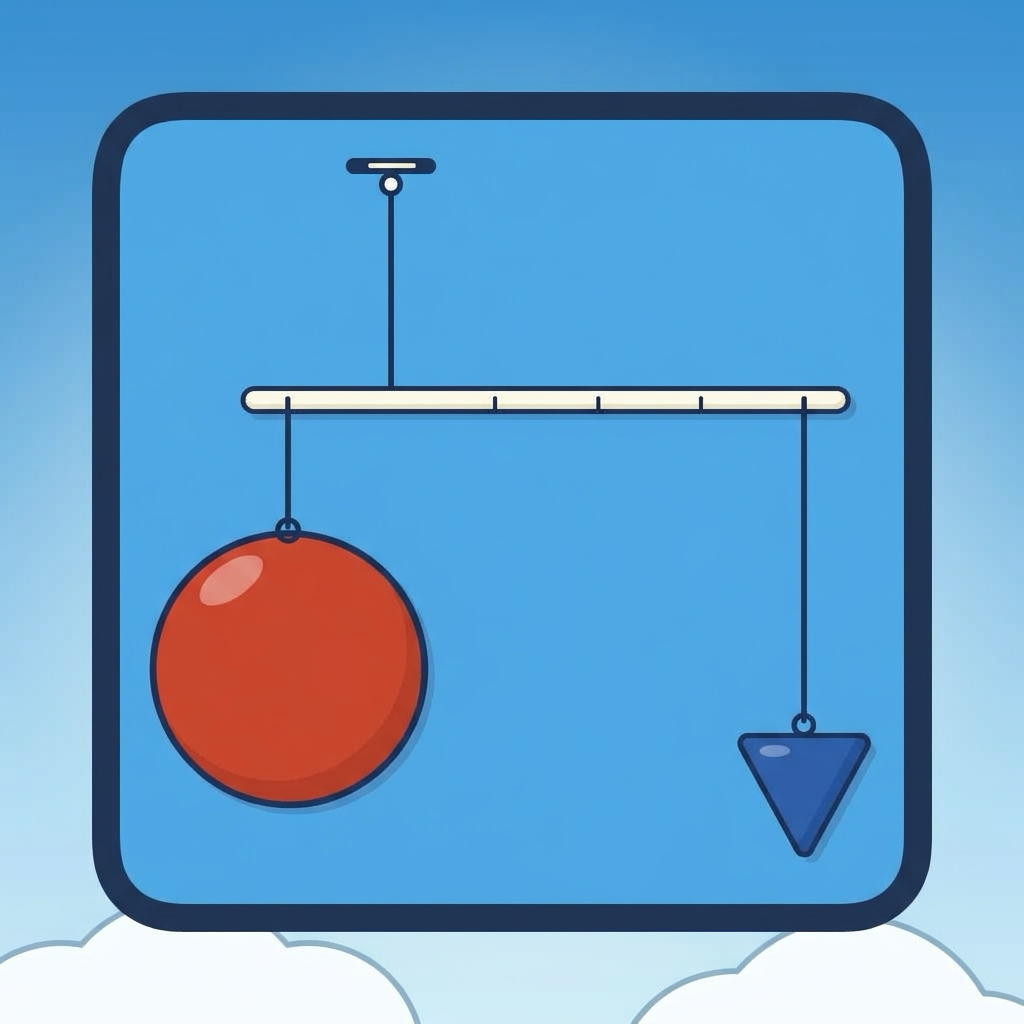
Every level of Tare is a hanging mobile that you balance with numbered weights, and none of the 80 has a word on the playing field. There is no tutorial screen, no hand icon and no arrow. The puzzle had to teach the rule, the hidden weights and the cards that reveal them by itself. And because there is no text to label, accessibility couldn’t be a layer of button labels added at the end.
What the first levels teach, and how
| You need to know | How Tare shows it | Level |
|---|---|---|
| Level and still means solved | One piece in the tray, one empty hook. The only move balances the beam, and its pivot flashes as it crosses level | 1 |
| Every hook takes a piece | Two hooks, two equal 3s | 2 |
| The heavy side drops, and distance multiplies | A 2 and a 4 for notches 2 and 1. With the 4 far out the beam tips; swapped, 2 × 2 = 4 × 1 | 3 |
| The hook matters as much as the piece | A 3 already hangs three notches out; a 2 and two 1s must fill notches 1, 2 and 3 on the other arm | 4 |
| Anything hung can be moved | A 4 starts on the wrong hook and has to come off | 5 |
| A hanging beam pulls with everything below it | The first nested beam: a 1 three notches out balances a small beam carrying 3 | 7 |
| A card is a true statement | Two different shapes, both 4s, level on a card above a lever the card doesn’t picture | 10 |
| A beam with a secret won’t tell you | A “?” starts hung, and its beam sways instead of tilting | 11 |
| The sway climbs | A “?” on a lower beam makes the beam above it sway too | 13 |
Two signals run through all 80 levels:
- Every known weight states its value twice, as a numeral and as domino pips, and its size grows with its weight: 32 points across for a 1, 96 for a 9. A hidden “?” is always 52 points, whatever it weighs.
- A full but wrong board shudders once: a damped 1.2° shake over half a second, with a soft haptic. No red, no buzzer, no failure screen. A drop that misses every hook isn’t even that; the piece glides back to its slot.
Levels with one way forward
The rule for the first five levels was no text, no hand icons and no tutorial overlay. Instead, each level offers so little that the next thing to try is the lesson. Level 1 has exactly one possible move, and it solves the level. By level 5 you have dragged, filled, swapped and re-hung, because level 5 can’t be solved without moving the piece it starts with.
Three wordless helpers sit around those levels:
- Live tilt preview. Hold a weight over a hook and the whole mobile leans to where it would rest if you let go.
- A teaching line, on levels 1 to 5 only. After 15 seconds without a touch, a faint line arcs from a piece to a hook. It shows a move, not the solution.
- A short introduction for each kind of card. The first time a card appears, and again for the first secret, tilt, sum and ratio, the room dims on the card and the pieces it quotes, a line joins them, and one piece lifts once. There are at most five in the whole game, and none is saved: the game works out what you’ve seen from the levels you’ve solved.
From then on, picking up a piece lifts every card that mentions it, so the shape of the piece is the pointer.
No channel leaks a hidden weight
The deduction only works if the game keeps its own secrets. A beam carrying an unsolved “?” sways about 3° either side of level and never settles, because, as the design notes put it, “the scale cannot weigh a secret”. How to solve a balance puzzle explains why that matters. The same rule holds on every other channel:
- Size: the “?” bubble is one fixed size.
- Sound: with Sound on, each weight has its own note, and heavier is lower. A “?” makes an unpitched thud.
- Touch: a “?” always gives the same haptic strength.
- Speech: VoiceOver calls it “hidden teal drop” and never says a number, and its beam “cannot settle, hidden weight”.
What accessibility took
With no words on the canvas, labelling the buttons covers almost nothing. The board itself had to become something a screen reader can walk.
| Need | What Tare does |
|---|---|
| Playing without sight | VoiceOver reads the mobile as a tree: “Beam 2, hanging from Beam 1, left, notch 2.” A hook says what hangs on it or “empty hook”. Select a piece and every hook offers “Place the…”; a hung piece offers “Return to tray”. Each beam reports balanced, which side is heavier, or that it cannot settle. Cards read as sentences: “Reference scale, level. Left, notch 1: …” |
| Colour blindness | Colour never carries meaning alone. Each of the ten shapes has one colour, and every known weight shows its numeral and pips |
| Low vision | Numerals and pips clear 3:1 by default. The High contrast switch, or the system’s Increase Contrast, swaps in flat fills that clear 4.5:1 |
| Large text | The numeral grows with Dynamic Type; at the accessibility sizes it gives way to the pips instead of overflowing a small piece |
| Motion sensitivity | Reduce Motion stops the idle drift and the tilt parallax, and turns the sway into a slow pulse in opacity: same meaning, no movement |
| Transparency | Reduce Transparency swaps the glassy bubble for a matte one with a dashed rim, at the same fixed size |
| Precise touch | A hook catches a piece from 60 points away, every piece has a touch target of at least 48 points, and a tap sends a hung piece home |
| Sound and haptics | Sound ships off, and no level needs it. The Haptics switch appears only on devices that have haptics, so not on iPads |
Tests hold this to account. One fills every hook of every shipped level using voice actions alone. Another plays levels 1 to 3 as a player who cannot see the screen: it knows only what an empty hook and a level beam sound like, and how to put a piece back. Others recompute every contrast ratio when the tests run, and check that two pieces share a colour only when they share a shape.
Where the words went
Tare isn’t wordless everywhere. Settings, the four chapter names (The Hang, The Secret, The Cascade, The Exhibition), the four world names and the unlock screen use words. The app’s whole string catalog is 108 entries, and about two-thirds of them exist only for VoiceOver.
The canvas is held to its rule by a test that reads the code drawing a level and fails if it finds any text other than a weight’s numeral and the “?”.
The plan had been English-only VoiceOver at launch, on the reasoning that the gameplay is wordless. That holds for the canvas, but for a player who can’t see it the spoken clauses are the game, and an English game inside a store listing written in 50 locales was where the wordless argument stopped. On 20 September I made the whole app ship in all 50 locales. Every spoken line was already a whole clause with placeholders, so a translator could reorder it.
Right-to-left languages turned up a different problem. In Arabic, Hebrew and Urdu, SwiftUI mirrored the drawing of the mobile but not the drag, so a player had to touch the mirror image of a piece to lift it. A mobile is a physical toy, so it is now drawn left to right in every language while the menus mirror, and VoiceOver’s “left arm” matches what’s on screen.
Decisions that changed late
- Sound off by default (20 September). I played the finished build and didn’t want its sounds on unless a player asks. That cost a teaching channel, since the notes taught weight by ear. Level 1’s lesson now rests on the beam going level and still, which works because the level allows no other action.
- The idle line became a teacher only (19 September). It used to appear by itself after 8 seconds on every level, and it made levels too easy. Now it appears unasked only on levels 1 to 5. Elsewhere, hints are a Settings switch, off by default: each press draws one line from the next piece to its hook, never for the last piece, and the first press on an attempt costs that attempt’s third star.
Tare is a free download for iPhone and iPad on iOS and iPadOS 18 or later. Chapter I’s 20 levels, onboarding included, are free to keep, and one $2.99 purchase unlocks the other 60; why it is priced that way is its own post. If you came for the rule-learning, compare Baba Is You, whose rules are built out of word blocks, and DragonBox Algebra, which also teaches through balancing. For the wider field, see the best logic puzzle games for iPhone.
Questions
Frequently asked
Does Tare have any text?
How does Tare teach its rules without a tutorial?
Can you play Tare with VoiceOver?
Is Tare colour-blind friendly?
Can children or people who don't read English play Tare?
Does Tare support Reduce Motion, Dynamic Type and high contrast?
Mentioned in this post
Apps in this story
More from the journal