
Journal · October 9, 2026 · 9 min read
How to solve a balance puzzle, and how Tare proves all 80 of its levels
Tare's 80 levels are hanging mobiles you balance with numbered weights, and some of the weights are hidden. Every one was built by hand, and none ships until the test suite proves three things about it: it has exactly one answer, its cards alone name every hidden weight, and its decoys fit nowhere. Here is how to solve one, and how that proof works.
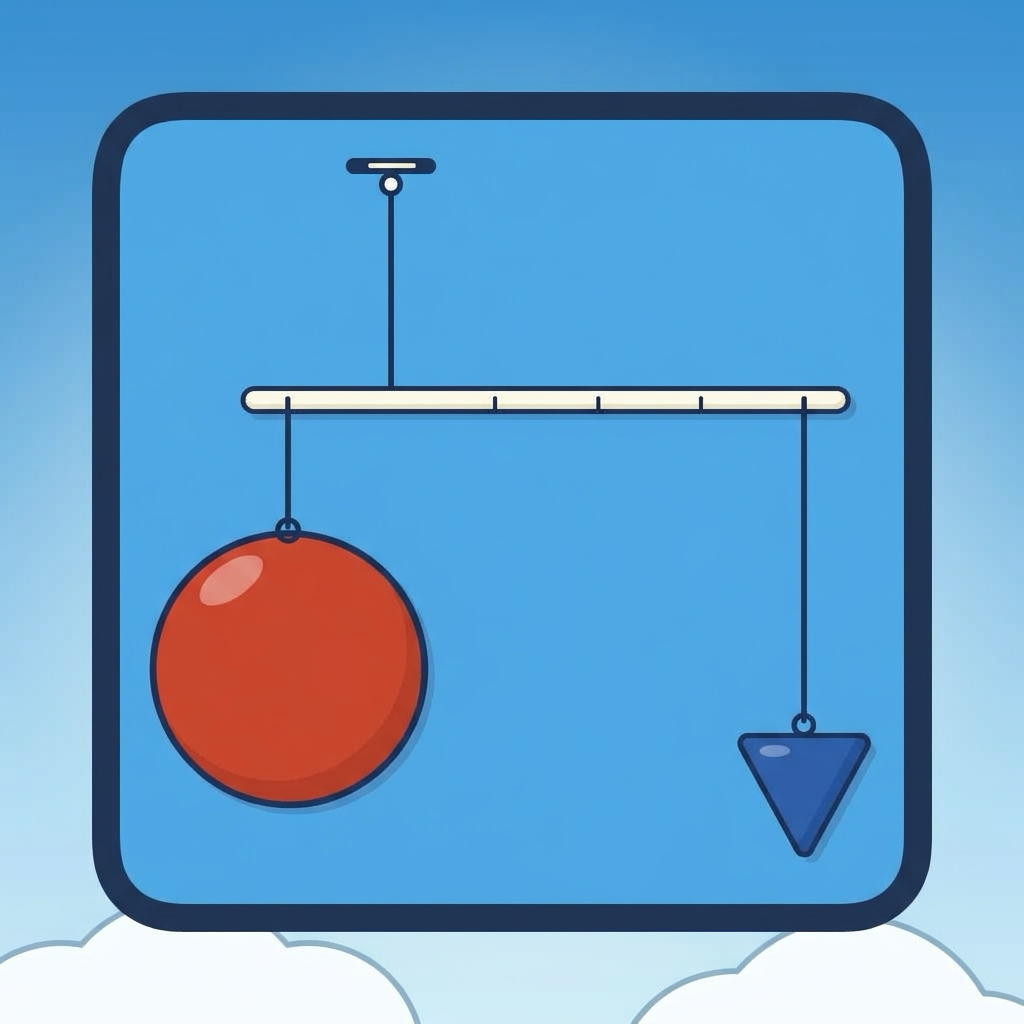
Every level of Tare is a hanging mobile: beams on strings, hooks on the beams, and a shelf of weights numbered 1 to 9. You hang every weight so that every beam balances at once. Some hide inside a “?” bubble drawn at one fixed size, and the scale won’t tell you what they weigh; small picture cards above the board will. All 80 were built by hand, and none ships until a gate in the test suite has proved three things about it:
- Exactly one arrangement balances.
- The cards alone pin every hidden weight to a single value.
- Every decoy fits no balanced arrangement at all.
First the method, on a real level, then the gate.
The one rule: weight × distance
A beam is level when the turning force on each side of its pivot is equal. Each weight contributes its number times its distance from the pivot, counted in notches from 1 to 4. A 2 two notches out balances a 4 one notch out, because 2 × 2 = 4 × 1. Several weights on one side add up.
Beams can hang from other beams. A hanging beam pulls on its hook with the total of everything below it, and the beams themselves weigh nothing. So a child beam has to balance on its own, and its parent sees only one number: its load.
A level is solved when every hook holds a weight and every beam is level. Two pieces of the same weight are interchangeable, so swapping them is not a second answer.
Read the cards before you hang anything
On a real scale you could weigh a secret by hanging it and watching the beam tip. Tare doesn’t allow that. A beam carrying an unsolved “?” doesn’t tilt: it sways slowly, about 3° either side of level, and never settles, and the sway climbs to every beam above it. If it tilted truthfully, you could binary-search every hidden value by reading angles, and the puzzle would become measurement.
So the cards are the only scale for a secret. Each card is itself a small beam:
| Card | What it shows | What it tells you | From the game |
|---|---|---|---|
| Equal | Level, equal arms | Both sides weigh the same; two pieces on one side add up | Chapter II, level 5: “?” = 1 + 3, so 4 |
| Tilted | Heavy side down | That side is strictly heavier; two tilts can bracket a value | Chapter II, level 3: heavier than the 3, lighter than the 5, so 4 |
| Ratio | Level, unequal arms | Multiply each side by its notches | Chapter II, level 10: “?” at notch 1 balances a 4 at notch 2, so 8 |
| Twin rule | No card; it holds everywhere | Pieces with the same silhouette weigh the same | Solve one twin and you know both |
A card can also show a weight that isn’t in your tray, drawn only for comparison. Chapter II’s first level sets its “?” against a 3 you don’t own.
A worked example: Chapter II, level 14
A top beam with no hooks of its own carries two beams, two notches either side of its pivot. The left beam has a hook one notch either side. The right beam has hooks two notches and one notch left, and one notch right. The tray holds a “?”, a 3, two 6s and a 7: five pieces for five hooks.
- The cards. One card shows the “?” heavier than a 1. The other shows it lighter than the 3. Weights are whole numbers, so the “?” is 2.
- The top beam. Both children hang two notches out, so they balance only if they carry the same load. The tray totals 2 + 3 + 6 + 6 + 7 = 24, so each child carries 12.
- The left beam. Equal arms with one hook each means two equal weights. The only pair is the two 6s, and 6 + 6 = 12.
- The right beam. It gets the 2, 3 and 7, also 12. Its one right-hand hook must match both left hooks. Put the 7 there, the 2 two notches out and the 3 one notch out: 4 + 3 = 7. With the 2 or the 3 on the right, the left side comes to at least 11.
- Check the top. 12 × 2 on each side: 24 against 24.
While you play it, the left beam settles level as soon as both 6s are on, because nothing on it is hidden. Once the “?” hangs on the right beam, that beam and the top beam sway until the level is solved.
Habits that solve most levels
- Cards first, then arrange. They are always enough to name every “?”.
- Work from the bottom up. A parent sees only a child’s total.
- Equal distances mean equal loads. Two beams hung equally far either side of a pivot carry the same total.
- Count the tray. Every hook takes one weight, so pieces minus hooks is the number of decoys.
How a level is built
These 80 are the second attempt. On 1 September I played the first two finished chapters: every level was a single flat beam, the cards were hard to read, and there was no reason to keep going. The next day the arc was redesigned so that chapters mix mechanics and the mobile changes shape from level to level.
The design notes call the method “sketched by hand, proven by machine”. A level starts as a silhouette, one of ten families: bar, lever, pendant, yoke, fork, outrigger, cradle, ladder, staircase and tree. No structure appears twice in the game, and from level 6 on, no two neighbours on a chapter’s four-column grid share a family.
A search in the test target then fills in the numbers. It runs combinations of weights from 1 to 9, one per hook, through the game’s own solver and keeps those with exactly one answer, every piece hung and no beam side above 36, ranked by how badly a player who never counts does or by how much work the cards have to do. A card assistant proposes cards and keeps only sets the deduction engine accepts. Then I choose by hand: nice numbers, a symmetry that misleads, a satisfying last piece.
Every level stays inside the same limits: weights 1 to 9, hooks at notches 1 to 4, at most eight pieces, eight hooks, three beams deep, three hidden weights, three decoys and three cards, and 36 on any side of any beam, so the arithmetic fits in your head.
What the gate proves
As with Millrace’s levels, the gate is a test that runs over every bundled level, not a script run once.
Exactly one arrangement. The solver tries every way to fill the hooks, up to 40,320 for eight pieces on eight hooks, branching on weights rather than pieces and filling the deepest beams first so a beam that can’t balance is abandoned early. It may call a level unique only if it searched to the end. Its shortcuts are tested against a deliberately naive solver: on an eight-hook test level with 882 solutions, both find the same 882.
Every “?” from the cards alone. A separate check ignores the mobile. It tries every value from 1 to 9 for each hidden weight, at most 729 combinations for three, against every card and the twin rule. Exactly one may survive, and it must be the level’s real weight. Another check confirms each card is true as drawn, with its own arithmetic rather than the deduction engine’s, so a bug in one can’t hide a card that lies.
Every decoy fits nowhere. The pieces flagged as decoys must be exactly the pieces no balanced arrangement uses. Because the solver counts by weight, a decoy can never share a weight with a piece that hangs: there would be no fact about which of the two is spare.
No decorative cards. On a level with a “?”, every card must belong to the smallest set of cards that pins down some hidden weight.
Each check has a deliberately broken level in the suite that it must catch: one with two answers, one with a lying card, one whose “?” the cards leave open. A failure names the level and the rule it broke. For this post, all 80 were also re-checked by a brute-force script that shares no code with the app: 80 single answers, every “?” pinned to its real weight, every decoy unused.
The 80-level ramp
| Chapter | Levels | Hooks | Beams deep (1 / 2 / 3) | Levels with a “?” | Hidden weights (most in one level) | Decoys | Cards |
|---|---|---|---|---|---|---|---|
| I · The Hang (free) | 1–20 | 2–6 | 10 / 7 / 3 | 4 | 4 (1) | 0 | 5 |
| II · The Secret | 21–40 | 3–6 | 6 / 9 / 5 | 20 | 33 (2) | 0 | 35 |
| III · The Cascade | 41–60 | 4–7 | 1 / 9 / 10 | 13 | 29 (3) | 1 | 30 |
| IV · The Exhibition | 61–80 | 4–6 | 2 / 11 / 7 | 14 | 28 (3) | 30 | 24 |
| All | 80 | 2–7 | 19 / 36 / 25 | 51 | 94 | 31 | 94 |
Counting all 80 in order, each idea arrives on a fixed level: the first nested beam at 7, the first card at 10, the first “?” at 11, three beams deep at 15, the first sum card at 17, a weight you don’t own at 21, the first bracket at 23, the first ratio at 30, three hidden weights at 51, and one decoy at 60 as a preview of Chapter IV, where every level has one or two.
The solver’s own counts show the climb. Chapter I’s first level took it 2 weight-into-hook trials; Chapter IV’s level 19 took 600. On levels with nothing hidden, a simulated player who never counts hangs everything at random, then keeps making the swap that most reduces the tilt, from 300 fixed starts. It solves the first three levels every time, Chapter I’s level 18 one time in ten, and the finale 13% of the time. Ignore the cards on Chapter IV’s level 17 and 294 combinations of hidden values and arrangements balance; with them, one does. Chapter IV’s level 11 puts exactly 36 on one side of a beam, the cap.
Tare is a free download for iPhone and iPad. Chapter I’s 20 levels are free to keep, and one $2.99 purchase unlocks the other 60. There are no ads, it works offline, and its App Store privacy label reads Data Not Collected; the privacy policy has the details. How the first levels teach all of this without a word is in designing a puzzle with no words, and why the rest costs $2.99 once is in no ads, no subscription. If a level seems to need a guess, it doesn’t: the cards are enough, and the tests have checked that they are.
Questions
Frequently asked
How do you solve a balance puzzle?
What is a hanging mobile puzzle?
Why does a beam with a “?” sway in Tare instead of tilting?
What do the clue cards in Tare mean?
How does Tare make sure every level has exactly one answer?
What is a decoy in Tare?
Is Tare free?
Mentioned in this post
Apps in this story
More from the journal